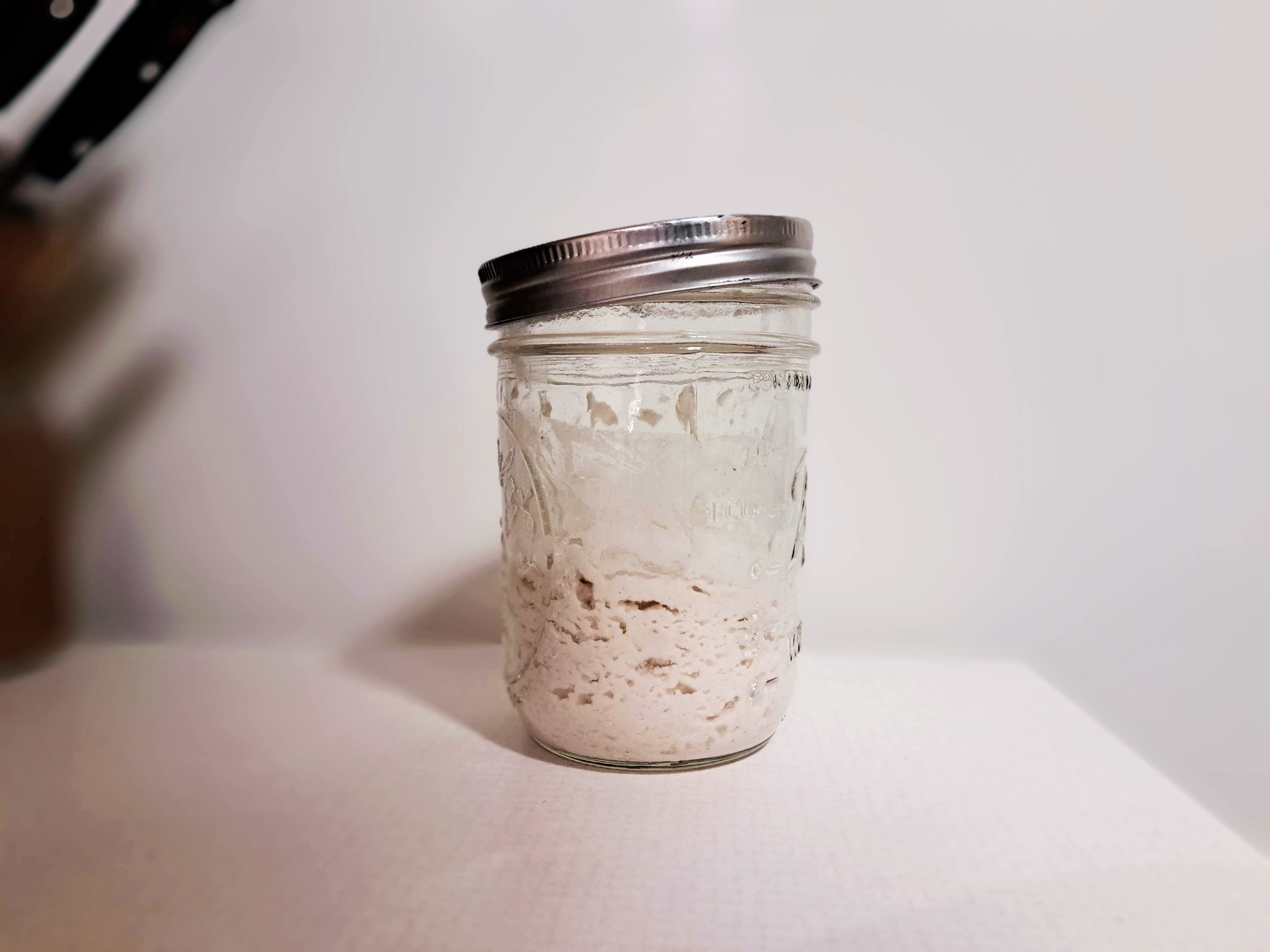
So, you want to try Sourdough but are gluten-free? No problem! With gluten-free starter, you can have your cake and eat it to 😉
If this process is completely new to you, PLEASE do not be intimidated! Your starter is stronger than you realize; the most important ingredient in this process is patience. The process I have outlined below only takes 7 days, and this is the hardest part.
Follow my simple steps to make your very own gluten-free starter!
What you’ll need:
- Rye Flour
- Bob’s Red Mill 1-to-1 Gluten Free Flour (you can use nearly any gluten free flour, I’ve just found this blend to work well for me)
- Other flours to try: Sorghum Flour (great whole-grain option), Brown Rice Flour, Buckwheat Flour, Teff Flour, Quinoa Flour, Oat Flour (be sure to use certified gluten free oats), or Millet Flour
- Filtered water is ideal for your starter as Chlorine can impact it’s growth
- 2 Glass Jars (preferably without a lip) and with a lid
- Rubber band (optional)
- Long Spatula
- Scale
Day 1 AM
*Note: Try to keep track of what time you feed your starter at. This will help you understand how and when it grows and help it to maintain a schedule.

Using your scale, add 20g gluten-free flour and 15g warm-room temp water to your glass jar. Mix using your long spatula. Set a lid loosely on top of the jar and set the jar in a moderately warm spot. Ideally, your kitchen temperature sits around 76o F. I keep mine on the counter near my stove. Allow to sit until tomorrow morning.
*Another Note: Placing a rubber band around your jar to mark your starter can be a helpful way to keep track of growth!

Day 2 AM
Around the same time frame as yesterday morning:
Place a clean jar on your scale. Tare your scale to bring it back to 0g. Add half of yesterday’s mixture (throw away the excess), 20g gluten-free flour and 15g warm water to the clean jar. Mix using your long spatula, set your lid loosely on top, and place the jar in the same spot as yesterday. Allow to sit until tomorrow morning.
Day 3 AM

You will repeat what you did on Day 2 AM.
Around the same time frame as yesterday morning:
Place a clean jar on your scale. Tare your scale to bring it back to 0g. Add half of yesterday’s mixture (throw away the excess), 20g gluten-free flour, and 15g warm water to the clean jar. Mix using your long spatula, set your lid loosely on top, and place the jar in the same spot as yesterday. Allow to sit until tomorrow morning.
Day 4 AM

Today you can begin feeding your starter a 1:1:1 ratio. This means equal parts of starter to gluten-free flour to water. For example, if you put 10g of your starter into a clean jar, you would feed it with 10g all-purpose flour and 10g water. Here I did 20g starter, 20g gluten-free flour, and 20g water. It is up to you how many grams of starter you choose to feed (10g, 20g, 30g, etc.). Just know that the more starter you feed, the more you will have!
*Do not freak out if it seems like your starter isn’t growing when you make the transition to the 1:1:1 ratio.

Day 5 AM
In the morning of Day 5 continue with the 1:1:1 feeding ratio.
Place a clean jar on your scale. Tare your scale to bring it back to 0g. I used 20g starter, 20g gluten-free flour, and 20g water. Mix, set your lid loosely on top, and place the jar in the same spot as yesterday. Allow to rest until tomorrow morning.
Day 6 AM
Today you can increase your feeding ratio to 1:2:2. This means for every 1 part of starter, add 2 parts flour and 2 parts water. Place a clean jar on your scale. Tare your scale to bring it back to 0g. I combined 10g starter, 20g gluten-free flour, and 20g water.

Day 7 AM
You can begin increasing your starter feedings whenever you notice it is bubbly and close to doubling in size. I typically feed it 1:2:2 ratios, and I have noticed that gluten-free starter grows slower than my traditional starter, so I only feed it once a day.
Your starter will perform better with age – I’d recommend waiting until your starter is at least 14 days old before using it to bake.
Need to Put a Pause on Feedings?
If you need to put a pause on feedings, you can put your gluten-free starter in the fridge in a sealed jar for anywhere from 1-2 weeks.
From Now On
You get to experiment with the ratios you feed your starter. Work to create a routine that helps you to learn how your starter grows – this will change with the seasons. Winter slows my starter down, and summer it will grow faster.
It is crucial that you always remove some starter (the excess or discard – see below) before feeding. Otherwise, your starter will 1. become huge and 2. become over-fermented.
Leave a Reply